

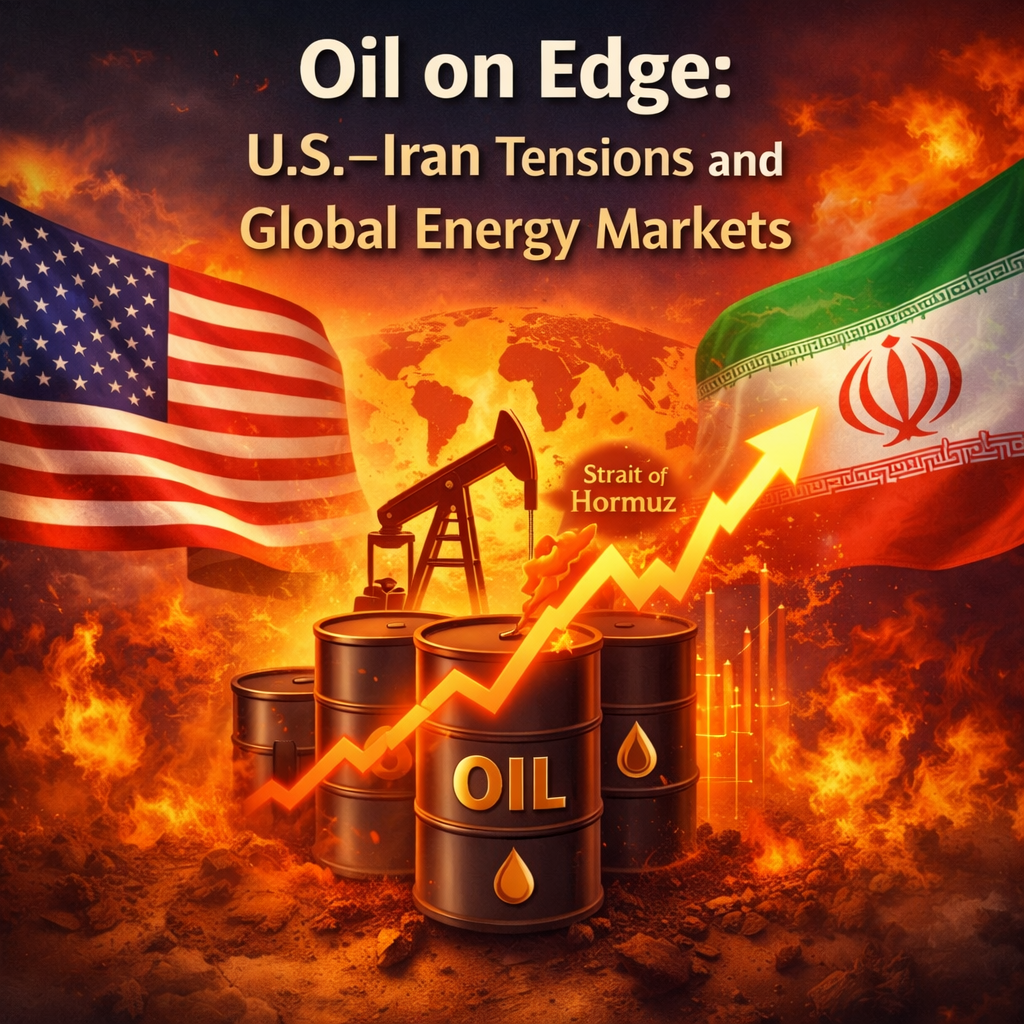
When the United States and Israel launched joint air strikes on Iran on 28 February 2026, the world did not just hold its breath — it checked oil prices. Within hours, Brent crude surged more than 6%, briefly touching $82 per barrel. Within days, it was trading near $120. By mid-March, with the Strait of Hormuz effectively shut to tanker traffic, the International Energy Agency described the situation as the “greatest global energy security challenge in history.”
This is no longer a hypothetical scenario about what might happen if U.S.–Iran war tensions escalate. It is already happening. This article explains what the conflict means for global oil markets, what it means for Pakistan, and what comes next.
What Triggered the Current Crisis
The conflict began on 28 February 2026 when U.S. and Israeli forces struck Iranian nuclear and military facilities. Iran retaliated with missile and drone strikes on U.S. bases in Qatar, the UAE, and Bahrain, and began targeting energy infrastructure across the Gulf — including Saudi oil fields, fuel storage terminals in Kuwait, and water desalination plants in Bahrain and Iran itself.
Iran also moved to interdict shipping through the Strait of Hormuz, the narrow waterway between Iran and Oman through which roughly 20 million barrels of oil pass every day — approximately one-fifth of global daily supply. Insurance companies quickly withdrew coverage for tankers attempting the passage, creating what analysts at Kpler described as a “de facto closure” of the strait even before Iran formally blocked it.
The result was immediate and severe. As the CSIS noted, during the first week of the conflict Brent crude rose about 18%. Then, when it became clear the disruption would not be short-lived, Brent surged as high as $119 per barrel when Asian markets opened on Monday 9 March — before settling back near $100. By the time the IEA published its March 2026 Oil Market Report, Brent was sitting around $92 per barrel, up $20 for the month.
The Strait of Hormuz: Why One Narrow Waterway Controls So Much
The Strait of Hormuz is only about 33 kilometres wide at its narrowest point, yet it carries the weight of the global economy on its shoulders. In 2025, roughly 20 million barrels of crude oil and oil products passed through it every day. Around 80 million tonnes of liquefied natural gas (LNG) — about 19% of global LNG supply — also flows through this corridor annually, according to Goldman Sachs Research.
The countries that depend most heavily on this route are Saudi Arabia, Iraq, Kuwait, and the UAE. Only Saudi Arabia and the UAE have alternative export pipelines, and even those have limited capacity. When tankers stopped moving, Iraq and Kuwait had no choice but to begin shutting in their oil wells in early March 2026, as local storage filled up with crude that had nowhere to go.
The IEA estimates that the near-standstill in Gulf exports has removed close to 20% of global oil supply from the market. More than 3 million barrels per day of refining capacity in the region has already shut down due to attacks and the absence of viable export routes.
What This Means for Oil Prices — The Numbers
The price impact has been dramatic and well-documented by major financial institutions:
Goldman Sachs Research estimated that traders were demanding approximately $14 more per barrel than before the conflict to compensate for increased risk — a figure consistent with the effect of a full four-week halt in flows through the Strait of Hormuz. If only half of flows are disrupted for one month, Goldman estimated the impact at around $4 per barrel above baseline.
The IEA, in its March 2026 Oil Market Report, noted that Brent futures came within reach of $120 per barrel before easing. The agency also cut its forecast for global oil demand growth in 2026 by 210,000 barrels per day, citing higher prices and a deteriorating economic outlook.
The Dallas Federal Reserve published research showing that a complete cessation of Gulf exports — removing close to 20% of global supply — would generate economic shocks comparable to the 1973 Yom Kippur War oil embargo, the 1979 Iranian Revolution, and the 1990 Gulf War. All three episodes caused recessions.
Pakistan’s Exposure: Particularly Vulnerable
For Pakistani readers, this crisis is not an abstract global story. It is already reshaping daily life.
Prime Minister Shehbaz Sharif announced emergency austerity measures in response to soaring global oil prices, including a four-day work week for public offices, 50% of government staff working from home, and a two-week closure of educational institutions. The Pakistan Cricket Board subsequently moved all PSL 2026 matches behind closed doors and concentrated them in Lahore and Karachi to reduce fuel consumption and large-scale movement.
Pakistan is heavily dependent on imported oil and LNG. Most of that energy comes through or from the Persian Gulf. With the Strait of Hormuz disrupted, Pakistan faces both direct supply shortages and the cascading effect of higher import costs on the rupee, inflation, and government finances.
The situation is further complicated by Pakistan’s western border with Iran. Analysts from Afghanistan and Pakistan have warned that instability could spill over into Balochistan through sectarian tensions or proxy activity, potentially forcing Pakistan to manage a two-front security challenge it cannot afford.
Impact on Natural Gas and LNG
The oil disruption is only part of the story. Qatar — the world’s largest LNG exporter — declared force majeure on its gas exports after Iranian drone attacks struck its infrastructure. Reuters reported that it may take at least a month for Qatar’s LNG production to return to normal levels.
Goldman Sachs Research estimated that if LNG flows through the Strait of Hormuz are fully halted for one month, European natural gas prices (measured by the Dutch TTF benchmark) could approach 74 EUR/MWh — more than double the pre-conflict level of around 31.6 EUR/MWh. A disruption lasting more than two months could push European gas prices above 100 EUR/MWh, according to Goldman.
Asian buyers, who collectively receive about 80% of Gulf oil exports and are heavy LNG importers, face acute exposure. Countries like India, with thinner strategic reserves and heavy reliance on Middle Eastern crude, are already seeing higher inflation, a weakening rupee, and growing pressure on growth forecasts.
Financial Markets and Investor Response
The conflict’s effects have spread far beyond the energy sector. Stock markets fell globally in the opening days of the crisis. Futures for the S&P 500, Nasdaq, and Dow were all down more than 1% when markets opened on 2 March 2026, according to CNN Business. Conversely, energy company shares rose — Exxon and Chevron both climbed pre-market — as did defence stocks including Northrop Grumman and Lockheed Martin.
Morgan Stanley warned that prolonged conflict could lead to higher oil prices, elevated inflation, and greater market uncertainty. The bank noted that sustained high energy prices could complicate the U.S. Federal Reserve’s decision-making: raising interest rates to fight inflation could slow economic growth at an already fragile moment.
The World Economic Forum described the conflict as “a structural shock to the world economy, delivered at a moment of geoeconomic fragility.” It warned that the damage will move in waves — first hitting oil, gas, shipping and aviation; then inflation, industrial costs and food security; and eventually trade routes, investment decisions and political stability.
Emergency Responses: Strategic Reserves and OPEC+
Governments and international bodies have moved quickly to limit the damage.
On 11 March 2026, IEA member countries unanimously agreed to release 400 million barrels of oil from their emergency strategic petroleum reserves to help address the supply disruption — one of the largest coordinated reserve releases in the agency’s history. Global observed oil inventories stood at approximately 8.2 billion barrels in January 2026, the highest level since February 2021, providing a meaningful buffer.
OPEC+ also announced early in the crisis that it would raise daily output by 206,000 barrels per day. However, energy analysts were sceptical this would significantly contain prices if physical disruption to Gulf exports continued. As JP Morgan analysts noted, the market had shifted from pricing in geopolitical risk to grappling with actual operational disruption — a qualitatively different and more serious situation.
What Happens Next: Three Scenarios
Scenario 1 — Short Disruption (1–2 months): The Strait of Hormuz reopens relatively quickly following diplomatic intervention or military resolution. Strategic reserve releases contain the price spike. Brent stabilises in the $85–95 range. Pakistan and other import-dependent nations face a painful but manageable adjustment.
Scenario 2 — Prolonged Disruption (3–6 months): Gulf infrastructure repairs take time. Iran continues targeting energy facilities. Brent stays above $100 for an extended period. Inflation rises sharply in import-dependent economies, central banks face difficult choices, and a global slowdown becomes increasingly likely.
Scenario 3 — Extended Conflict (6+ months): The Dallas Fed’s research suggests this scenario could produce economic consequences comparable to the 1970s energy crisis — acute supply shortages, currency volatility, stagflation, and recession risk in multiple regions.
The World Economic Forum noted that historically, every major oil shock has generated a policy response proportional to the pain it inflicts. That response is already underway — but its effectiveness depends on how long the conflict lasts.
The One Silver Lining: Accelerating the Energy Transition
Every major oil crisis in history has ultimately accelerated investment in alternatives. The 1973 embargo pushed the United States toward fuel efficiency standards. The 1979 shock drove European investment in nuclear power and gas diversification. This crisis is already making renewable energy, domestic gas production, and electric vehicles look considerably more attractive to governments and investors alike.
Morgan Stanley advised investors in 2026 to consider increasing exposure to defence, security, aerospace, and industrial resilience — sectors where government spending can drive multiyear demand regardless of how the conflict resolves.
For Pakistan, the crisis also strengthens the long-term case for domestic solar energy development, reducing the country’s dangerous dependence on imported fuel from one of the world’s most volatile regions.
Conclusion
The U.S.–Iran conflict of 2026 has done what analysts warned was possible for decades: triggered a genuine, large-scale disruption to global oil supply rather than merely a risk premium event. With the Strait of Hormuz effectively closed, Gulf producers shutting in wells, and Brent crude trading at levels not seen since 2022, the global economy faces a stress test whose outcome remains uncertain.
For Pakistan — geographically close to the conflict, economically dependent on Gulf energy, and already managing domestic fiscal pressures — the stakes are particularly high. The government’s austerity measures are a rational short-term response, but the deeper lesson of this crisis is the urgent need for energy diversification and greater self-sufficiency.
Frequently Asked Questions
Why did oil prices spike so sharply after the U.S. strikes on Iran?
Because approximately 20% of global daily oil supply passes through the Strait of Hormuz, which Iran moved to interdict. Insurance companies withdrew coverage for tankers, creating an effective closure of the waterway even before a formal blockade. Physical supply — not just risk — was disrupted from the first days of the conflict.
How high could oil prices go?
Brent crude briefly touched $119 per barrel in early March 2026. Goldman Sachs Research estimated that a full four-week halt in Strait of Hormuz flows would add approximately $14 per barrel to prices. The IEA noted that in a scenario where the disruption is prolonged, prices could remain well above $100 for months.
How is Pakistan affected specifically?
Pakistan is heavily dependent on imported oil and LNG from the Gulf. The government announced emergency austerity measures including a four-day work week for public offices and school closures. Rising import costs are adding to inflation and rupee pressure. Pakistan’s western border with Iran also creates potential spillover security risks.
Will OPEC+ be able to stabilise prices?
OPEC+ announced a modest production increase, but analysts do not expect this to fully offset Gulf supply losses as long as the Strait of Hormuz remains disrupted. Strategic reserve releases by IEA member countries provide additional short-term cushioning.
What does this mean for natural gas prices?
Qatar declared force majeure on LNG exports following Iranian attacks. Goldman Sachs estimated European gas prices could approach 74 EUR/MWh if LNG flows through the Strait are fully halted for one month — more than double pre-conflict levels.
Stay updated with the latest energy market news and its impact on Pakistan at Shark Times.



Leave a Reply
You must be logged in to post a comment.